


1.What is the basic principle behind how carbon content affects the hardness of cold-rolled coils?
Solid solution strengthening: Carbon atoms exist as interstitial solid solutions in the interstitial lattice of ferrite (α-Fe). Because carbon atoms are much smaller than iron atoms, they distort the iron lattice, generating localized stress fields and hindering dislocation movement. This lattice distortion increases the material's resistance to plastic deformation, resulting in improved hardness and strength.
Phase transformation and microstructure determination: Carbon content determines the microstructure of steel:
Low carbon steel (C < 0.25%): The microstructure is mainly ferrite with a small amount of pearlite. Ferrite itself is relatively soft, resulting in low overall hardness.
Medium carbon steel (C 0.25%~0.6%): The proportion of pearlite increases. Pearlite is a layered mixture of ferrite and cementite (Fe₃C, an extremely hard compound), with a hardness much higher than ferrite.
High carbon steel (C > 0.6%): More cementite appears in the microstructure, even forming network or granular carbides, significantly increasing hardness.

2.Is there a quantitative relationship between carbon content and the hardness of cold-rolled coils?
Empirical Formula: For hot-rolled or annealed carbon steel, tensile strength (proportional to hardness) has a roughly linear relationship with carbon content.
Additive Effect of Cold Rolling Work Hardening: For cold-rolled coils, hardness depends not only on carbon content but also on the cold rolling reduction rate. The dislocation density increases sharply during cold rolling, resulting in work hardening.
Quantitative Trend: At the same cold rolling reduction rate, a 0.1% increase in carbon content typically leads to a significant increase in hardness (e.g., HRB or HV) (e.g., HV may increase by 20-40 points). However, in the high-carbon range, the rate of increase in hardness tends to flatten due to the presence of brittle phases in the microstructure.
Tempering Effect: In cold-rolled, annealed, or tempered steels, the change in hardness with carbon content varies depending on the tempering temperature and carbide precipitation behavior.
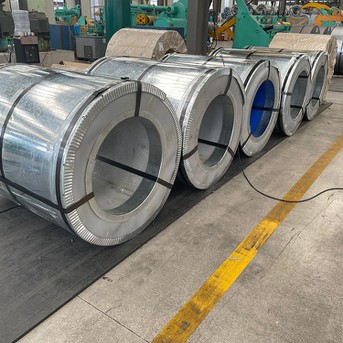
3.What are the differences in typical hardness values and application scenarios for cold-rolled coils with different carbon content ranges?
Ultra-low carbon steel: ≤0.01% (such as IF steel), used in automotive body panels (doors, hoods), and complex deep-drawn parts.
Low carbon steel: 0.02%~0.15% Used for appliance casings, general stamped parts, and tin-plated substrates.

4.How does the cold rolling process itself change the original hardness determined by carbon content?
Differences in work hardening rate:
Low carbon steel: Relatively low work hardening capacity. Although hardness increases after cold rolling, the hardening rate is slow.
High carbon steel: Extremely high work hardening rate. Due to the large amount of pearlite and carbides already present in the initial microstructure, dislocation movement is more severely hindered during cold rolling, resulting in a sharp increase in hardness with increasing reduction rate, and it is more likely to reach saturation.
Additive effect of final hardness:
The final hardness of a cold-rolled coil ≈ (matrix hardness determined by carbon content) + (work hardening contributed by cold rolling reduction rate).
For example: A low-carbon steel cold-rolled coil (such as SPCC) with a large reduction rate (>50%) may have a hardness (e.g., HRB 85) exceeding that of an annealed medium carbon steel (e.g., annealed 45# steel HRB 80). Therefore, the hardness can be adjusted within a certain range through the cold rolling process to meet different application requirements.
5.In production or application, how can the carbon content and process be adjusted according to hardness requirements?
Composition Design:
Target-Oriented: If the final product requires extremely high hardness (e.g., spring steel strip), high-carbon steel (e.g., 65Mn, C75S) must be selected, as work hardening alone cannot raise the hardness of low-carbon steel to the required level.
Target Plasticity: If excellent formability is required (e.g., deep drawing), ultra-low-carbon or low-carbon steel must be selected, as annealing cannot eliminate the plasticity loss caused by high carbon content.
Process Compensation:
Carbon Content Fluctuation Compensation: In continuous annealing or bell-type annealing processes, if a heat is found to have excessively high carbon content (leading to excessively high hardness), the annealing temperature can be appropriately increased or the holding time extended to reduce the hardness to the target range through softening (recrystallization and spheroidization).
Mechanical Property Tempering: For medium- and high-carbon steels, sometimes the softest state is not pursued; instead, a specific pearlitic morphology (e.g., sorbite) is obtained through "critical annealing" or "isothermal annealing" to balance hardness and toughness.
Common Misconceptions in Quality Judgment: It is important to note that the hardness of cold-rolled coils cannot be simply inferred from carbon content alone. At the same carbon content, the final hardness can vary greatly due to different cold rolling reduction rates and annealing processes. Therefore, users need to pay attention to both the material grade (corresponding to the carbon content range) and the supply status (annealed, 1/4 hard, 1/2 hard, fully hard, etc.) when using the material.