


1.Why does the galvanized coil deform after being unrolled?
Internal stress (the main cause):
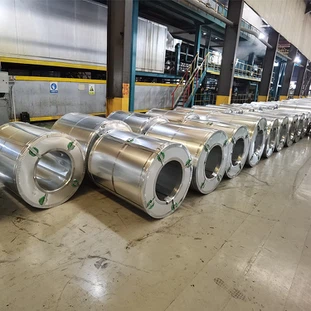
Coiling stress: Galvanized coils are inherently curled, and significant internal stress accumulates within the material during coiling and long-term storage.
Processing stress: Uneven internal stress can also be introduced during the previous rolling and galvanizing processes.
Straightening process: The straightening machine (leveler) repeatedly bends and straightens the steel plate using a series of rollers to eliminate these internal stresses and achieve a flat finish. However, improper adjustment or insufficient equipment capacity can prevent complete elimination of these internal stresses, leading to residual stress release after the steel plate is sheared, resulting in deformation.
Equipment and process factors:
Straightening machine accuracy: Aging and wear of the equipment can cause uneven roller parallelism and pressure.
Improper parameter settings: Parameters such as the straightening roll reduction and straightening speed that are inappropriate for the thickness and material of the plate can result in over-straightening or under-straightening.
Tension control: Instable tension control on the straightening line can pull or squeeze the plate, causing deformation. Material Issues:
Poor Sheet Shape: Some galvanized coils already have slight wavy or warped shapes when leaving the factory, which become apparent after flattening.
Uneven Thickness: Large thickness tolerances can also lead to different elongation rates in different areas under the same straightening pressure, resulting in deformation.
2.What are the common forms of deformation?
Waves
Edge waves: Waves appear along the edges of the plate.
Center waves: Waves appear in the middle of the plate.
This is the most common type of deformation, primarily due to uneven stress distribution within the plate, resulting in inconsistent compression or extension along its length.
Warping: The four corners of the plate are not aligned, resulting in a warped appearance. This is usually due to uneven local pressure from the leveling rollers.
Sickle bend: The entire plate exhibits a uniform arc across its width, resembling a sickle. This is primarily caused by inconsistent elongation on both sides of the plate during the leveling process.
3.How to prevent and reduce deformation?
Select high-quality raw materials:
Source from reputable steel mills to ensure precise control of plate shape and thickness tolerances.
Use high-precision flattening equipment:
Ensure the flattening machine is in good condition, with a sufficient number of straightening rollers (the more rollers, the better the straightening effect), and an advanced control system.
Optimize flattening process parameters:
Experienced operators precisely adjust the straightening roller pressure and flattening line tension based on the thickness, width, and material of each coil. This is the most critical operational step.
Proper lifting and stacking:
After flattening, plates should be lifted using multiple nylon slings in parallel to avoid deformation caused by single-point lifting with wire ropes.
Slabs should be stacked horizontally on a flat, sturdy platform. Stacks should not be too high to prevent deformation of the lower layers due to prolonged stress.
4.How to analyze the deformation of galvanized coils?
Minor deformation is common and generally does not affect use.
Severe deformation is a quality issue, rooted in poor raw material shape, poor precision of the flattening equipment, or improper operating procedures.
5.How to deal with slight deformation?
When placed flat on a platform, there is slight, localized undulation or wavering.
Pressing with your hand can temporarily flatten it, but it may rebound slightly when you release the pressure.
This deformation is generally not a problem for most non-precision applications.