


1.How does coating quality affect coating adhesion?
If adhesion is excellent (e.g., no coating peeling after passing a cross-cut test), the coating tightly "wrapped" the galvanized substrate, effectively isolating it from corrosive media such as moisture, oxygen, and salt, preventing direct exposure. Even if there are minor defects in the galvanized layer (e.g., pinholes), the coating can still form a "second barrier" to slow the spread of corrosion.
If adhesion is poor (e.g., blistering or peeling due to improper pre-treatment), the coating is prone to peeling during transportation, processing (e.g., bending and cutting), or use. The substrate in the peeled area loses its protection and rapidly oxidizes (rusting). Corrosion can even spread from the peeling area to the surrounding area ("collateral corrosion"), significantly reducing the overall protective performance of the galvanized coil and potentially shortening its service life by more than 50%. (For example, galvanized coil used outdoors with poor adhesion may develop extensive rust within 1-2 years, while coils with excellent adhesion can last for 5-10 years or more.)

2.How does coating quality affect coating uniformity and thickness?
If the coating is uniform (thickness deviation ≤ ±10%) and of appropriate thickness (typically 5-10μm for primer and 10-20μm for topcoat, adjusted depending on the application), it can achieve "uniform all-round protection": Whether on the flat surface, edges, or bends of the sheet, the coating blocks corrosive media, preventing "localized preferential corrosion" (e.g., rusting at the edges and then spreading to the center) caused by thin coating (e.g., missing coating at the edges or thickness less than 2μm).
If the coating is uneven (partially too thin or too thick):
Thin areas (e.g., less than 5μm) are prone to rapid wear and tear (e.g., friction during transportation, collisions during installation), losing their protective effect;
Excessively thick areas (e.g., over 30μm) are prone to "cracks" and "bubbles" due to uneven internal and external stress during curing, creating "weak points" (corrosive media can penetrate the substrate through cracks);
Furthermore, uneven thickness can lead to uneven stress during sheet processing (e.g., rolling and stamping), making the coating prone to partial detachment and affecting processing performance.

3.How does coating quality affect coating density?
A dense coating (no bubbles or rust in boiling water or salt spray tests) indicates a complete internal structure with no micropores. This makes it difficult for corrosive media like moisture and oxygen to penetrate the coating and reach the substrate. This ensures long-term protection even in high-humidity (such as coastal areas) or highly polluted (such as industrial areas) environments.
If the coating is poorly dense (e.g., due to impurities remaining in the coating due to incomplete filtration or air bubbles not being removed during curing, resulting in pinholes or raised particles in the coating),
Pinholes or pores can become "corrosion pathways" through which corrosive media can directly contact the galvanized substrate or zinc layer, causing localized corrosion (such as pitting) and, in turn, blistering of the coating (where gases generated by corrosion push the coating upward).
Impurity particles can easily form "stress concentration points," which can cause cracking in the coating and further expand the corrosion area. In severe cases, visible rust may appear within 3-6 months.
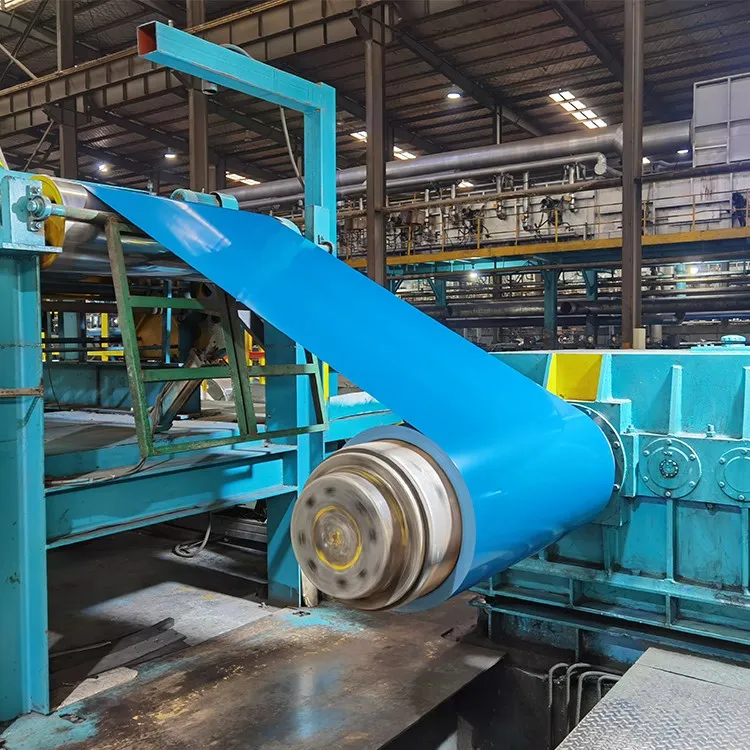
4.How does coating quality affect coating hardness and wear resistance?
If the coating has high hardness (e.g., pencil hardness ≥ H) and good abrasion resistance (low weight loss after passing the Taber abrasion test), it can withstand friction during transportation (such as contact between rolls), mechanical impact during processing (such as squeezing during bending), and bumps during use (such as accidental collisions with building exterior panels). The coating is less susceptible to scratching, abrasion, or peeling, maintaining an intact protective barrier for a long time.
If the coating has low hardness (e.g., pencil hardness < HB) and poor abrasion resistance:
It is easily scratched during transportation or processing (e.g., the coating is penetrated by sharp objects), directly exposing the substrate and becoming a starting point for corrosion.
During long-term use (e.g., indoor appliance panels), it is prone to "base exposure" (the coating wears away to the zinc layer) due to friction (e.g., frequent touching and cleaning). This not only affects the appearance but also causes rust at the exposed base, shortening the product's lifespan.
5.How does coating quality affect coating weathering resistance?
If the coating has excellent weather resistance (e.g., fluorocarbon coatings that show no noticeable fading or chalking after artificial accelerated aging tests):
In outdoor environments (e.g., building roofs and curtain walls), it can withstand long-term UV exposure (preventing coating degradation and chalking), rainwater erosion (preventing coating dissolution), and alternating hot and cold weather (preventing coating cracking), resulting in a service life of up to 15-20 years.
In industrial environments (e.g., chemical plants and seaside locations), it can withstand acid, alkali, and salt spray corrosion (preventing coating erosion), maintaining its protective properties.
If the coating has poor weather resistance (e.g., ordinary polyester coatings that do not meet standards and have weak UV resistance):
When used outdoors, the coating may fade (color difference ≥ 3 levels) and chalk (visible powder when rubbed) within 1-2 years. This chalking loses its density, allowing corrosive media to penetrate easily.
In hot and humid environments (e.g., rainy seasons in southern China), the coating is prone to blistering due to moisture absorption, eventually flaking off, causing rapid rusting of the substrate.