


1. Q: What are the main techniques for creating wood grain effects?
There are three main techniques: gravure printing, heat transfer printing, and embossing, each with its own focus:
Gravure Printing: The mainstream choice for industrial mass production. It involves coating ink onto a steel roller engraved with a wood grain pattern, transferring the texture onto a coated plate. Depending on the complexity of the pattern, single-color or multi-color printing can be achieved.
Heat Transfer Printing: Suitable for complex substrates or high-end customization. The principle is to print the wood grain pattern onto high-temperature resistant paper, and then sublimate and penetrate the dye into the coating through heating and pressure (usually 160-180℃, 5-8 minutes), forming a clear and durable pattern.
Embossing: Directly pressing a steel plate with a wood grain-engraved roller to create a raised texture, providing a realistic tactile feel. This technique can be combined with printed patterns to achieve both visual and tactile simulation.
2. Q: What are the key steps in producing a wood grain color-coated sheet?
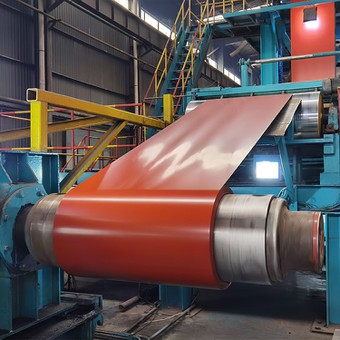
High-quality wood grain color-coated sheets typically use a continuous production line with "three coatings and three bakings." The process flow is as follows:
Substrate Preparation: Using galvanized or aluminized zinc steel sheets as the substrate, pre-treatment such as degreasing and cleaning is performed.
Primer and Top Coat: Applying primer and top coat, followed by baking and curing, is crucial for ensuring basic properties such as corrosion resistance and weather resistance.
Wood Grain Printing: The core step, using the aforementioned gravure printing technology, precisely prints the wood grain pattern onto the top coat layer.
Clear Varnish Application: Applying a layer of wear-resistant and weather-resistant transparent clear varnish (such as polyurethane or fluorocarbon varnish) over the wood grain pattern, followed by a final baking to form a protective layer.

3. Q: What are the advantages of wood-grain coated steel panels compared to real wood?
This "steel-for-wood" approach has significant advantages in several aspects:
Low cost: The overall cost is far lower than solid wood. For example, the cost of wood-grain coated steel wall panels is about 1/3 to 1/2 of that of solid wood siding.
Superior performance: It completely solves the inherent problems of wood such as susceptibility to moisture, insects, deformation, and flammability, making it more durable and safer.
Environmentally friendly and healthy: It reduces the consumption of natural wood, and the production process is more environmentally friendly.
High simulation: Modern technology can not only realistically reproduce the texture and color of various precious woods, but also replicate the natural knots and growth patterns of wood, and simulate realistic uneven textures through embossing.
4. Q: Where are wood grain coated panels typically used?
Its applications are very broad, covering multiple aspects such as construction, decoration, and industry:
Exterior Walls: Used as a replacement for solid wood cladding or stone to create rustic or modern style exterior wall decorations for villas, guesthouses, etc.
Interior Decoration: Used as ceilings, wall panels, door and window frames, etc., adding a warm wood feel to interior spaces.
Furniture Manufacturing: Widely used for cabinet doors, wardrobes, bookcases, and other furniture panels, offering both aesthetics and durability.
Appliance Housings: Used for the panels of refrigerators, air conditioners, and other home appliances, enhancing the product's appearance and quality.
5. Q: What should I pay attention to when choosing wood grain coated steel sheets?
To ensure product quality and lifespan, the following points should be considered when selecting:
Coating System: Clearly define the complete structure of the coating: primer, topcoat, printing layer, and clear varnish. The type of clear varnish protecting the pattern (e.g., polyester, fluorocarbon) directly determines the product's abrasion resistance and outdoor weather resistance. For outdoor projects, fluorocarbon clear varnish should be prioritized.
Substrate Material: The type and thickness of the substrate's plating determine the product's corrosion resistance. For outdoor or high-humidity environments, aluminum-zinc coated substrates or high-coating-weight hot-dip galvanized sheets should be selected.
Printing Process: Understand whether it is ordinary printing or 3D printing. High-quality 3D printing produces more realistic effects and clearer wood grain.
Brand Reputation: Choose suppliers with a good reputation and be wary of low-priced products that cut corners (e.g., reducing the number of coating layers), as this may affect the product's lifespan.