


The selection and design of photovoltaic (PV) support systems are determined by the number and dimensions of PV modules, optimal tilt angle, installation location, and mounting method, all calculated based on the total capacity of the PV power generation system. When designing PV supports, the primary requirement is structural reliability, with full consideration of load-bearing capacity, wind resistance, seismic performance, and corrosion resistance to ensure long-term stable operation of the system.

The design of rooftop PV supports must be tailored to different roof structures. For sloped roofs, supports can be designed parallel to the roof slope, with a height of approximately 10cm from the roof surface to ensure ventilation and heat dissipation for PV modules, or configured as a front-low, rear-high tilted support to match the optimal solar absorption angle, maximizing solar energy capture by the modules. For flat roofs, triangular support frames are generally adopted, with the tilt angle of the support surface set to the optimal reception angle for PV modules. All rooftop PV supports must be connected to the main structure of the building, not just the roof materials, to guarantee structural safety.

For roofs where concrete foundations can be constructed, supports are fixed by partially removing the roof waterproof layer, exposing the concrete surface, and ideally connecting to the steel reinforcement in the roof concrete by welding with embedded bolts in the foundation. If welding to steel reinforcement is not feasible, embedded steel bars can be driven into the roof, or the foundation area can be treated to create an uneven surface to enhance adhesion between the roof and concrete foundation, followed by secondary waterproofing treatment on the damaged waterproof layer to prevent leakage.
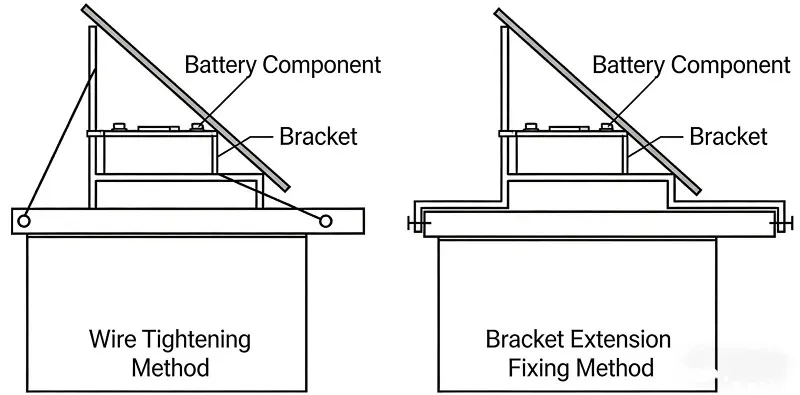
For roofs that cannot support concrete foundations, angle steel supports are generally used to directly fix PV modules, with fixing methods including wire rope (or iron wire) tensioning and support extension fixing. For triangular supports, the gap between the lower edge of PV modules and the roof surface must be greater than 15cm to prevent rainwater from splashing mud onto the module glass and causing soiling.
Rooftop PV supports can be fabricated by welding angle steel, channel steel, and other galvanized steel materials, or directly selected from specialized C-channel steel stamping supports or aluminum alloy supports produced by professional manufacturers. These dedicated rooftop PV supports include flat roof steel/aluminum alloy supports, adjustable tilt angle rooftop aluminum alloy supports, color steel tile rooftop aluminum alloy supports, and glass tile rooftop aluminum alloy supports, among others. When designing and selecting professional supports, the specific specifications, dimensions, and technical parameters can be referenced from the technical manuals provided by support manufacturers.
Core Material Performance Comparison
| Material Type | Weight | Corrosion Resistance | Installation Efficiency | Cost | Ideal Application |
|---|---|---|---|---|---|
| Galvanized C-Channel Steel | Medium | Excellent (25+ year service life) | High (modular prefabrication) | Cost-effective | All rooftop types, especially heavy-load sloped roofs |
| Aluminum Alloy | Lightweight | Excellent (30+ year service life) | High (lightweight, fast assembly) | Higher | Load-sensitive flat roofs, high-aesthetic residential/commercial roofs |
| Traditional Angle/Channel Steel | Heavy | Poor (requires regular maintenance) | Low (on-site welding) | Low upfront cost | Not recommended for long-term rooftop use |
In the journey of rooftop PV project construction, the support system is the invisible backbone that ensures the safety and efficiency of power generation. Whether it is a sloped roof, flat roof, or special lightweight roof, a scientifically designed, reasonably selected, and standardly installed PV support system can not only guarantee the structural safety of the building but also maximize the power generation efficiency of the PV array, creating long-term stable economic benefits for the project.
If you have specific rooftop PV project requirements, our professional team can provide customized support design solutions tailored to your roof type, module specifications, and local environmental conditions, ensuring compliance with safety standards and optimal power generation performance.
Frequently Asked Questions (FAQ)
Q1: Can I use ordinary steel for rooftop PV support systems?
A: Ordinary steel is not recommended. It has poor corrosion resistance and heavy weight, which may cause rust and roof overload after long-term use. Galvanized steel or aluminum alloy is the standard choice for rooftop PV supports, ensuring 25+ years of service life.
Q2: How to avoid roof damage during PV support installation?
A:For concrete roofs: Use anchor bolts to connect supports to the main structure (not directly to the waterproof layer).
For light steel/color steel roofs: Adopt the wire rope tensioning method to avoid drilling or cutting the roof panel.
Choose factory-prefabricated specialized supports to reduce on-site construction damage.
Q3: What factors affect the power generation efficiency of rooftop PV systems?
A:Support Tilt Angle: Align with the local latitude to maximize solar absorption.
Ventilation: Maintain a 10cm gap between the support and roof for heat dissipation (reducing module temperature by 5-10℃ improves power generation by 3-5%).
Material Selection: Lightweight supports reduce roof load, allowing more modules to be installed, increasing total power generation.
Q4: Do rooftop PV supports need seismic design?
A: Yes. All rooftop PV support systems must comply with local seismic design codes. For seismic zones, use high-strength C-shaped steel or aluminum alloy supports with seismic bracing components to enhance structural stability during earthquakes.