


Q: In galvanized coil production, what specific process does the surface smoothing process refer to?
A: It specifically refers to the "finishing" (also known as leveling) process, which is usually located between the post-galvanizing cooling section and the chemical treatment section of a continuous hot-dip galvanizing production line. This process uses a two-roll or four-roll finishing mill. The upper and lower rolls apply a certain pressure to the galvanized and cooled strip steel, causing a slight elongation deformation, thereby eliminating microscopic unevenness on the zinc layer surface, improving the strip shape, and providing a uniform surface condition for subsequent passivation, oiling, and other processes.
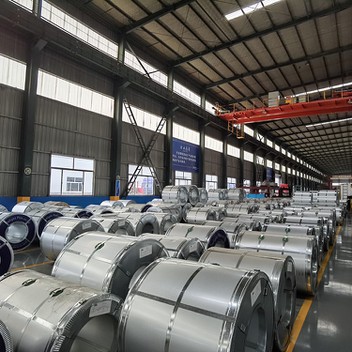
Q: What are the practical effects of finishing on the surface appearance and feel of galvanized coils?
A: Finishing significantly improves the surface quality of galvanized coils. After finishing, any unevenness or roughness that might have been present in the zinc coating is smoothed out, resulting in a finer, more uniform surface with a soft metallic luster or matte finish. Simultaneously, the finishing rollers undergo specific texturing treatments (such as EDM texturing), which transfer controllable micro-roughness onto the coating. This provides the galvanized coil with excellent paint adhesion and a uniform surface feel, eliminating minor defects such as fingerprints or whetstone scratches. For automotive or appliance panels requiring further painting, a finished surface is more conducive to paint film leveling, preventing orange peel or pinholes.
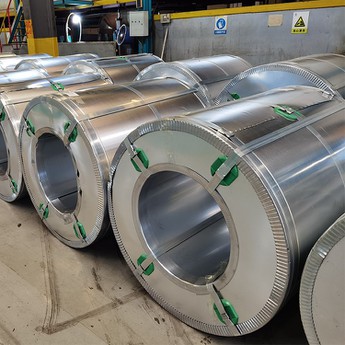
Q: How does finishing improve the shape and mechanical properties of galvanized coils?
A: Finishing mills apply tension and rolling force to the strip, causing an elongation of approximately 0.5% to 2% (called finishing elongation). This slight elongation eliminates shape defects such as edge waviness, center warping, or camber, making the strip straighter. From a mechanical perspective, finishing introduces a large number of movable dislocations into the galvanized coil matrix, temporarily eliminating the yield plateau caused by cooling after annealing, thus significantly reducing the yield point elongation. This effectively prevents slip lines (Lüders bands) from forming during subsequent stamping, resulting in better forming stability and surface appearance.
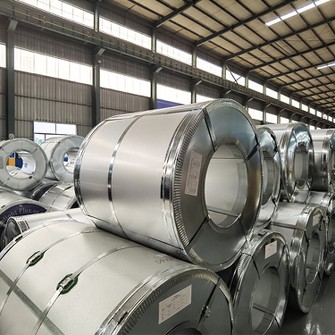
Q: What key process parameters need to be controlled during the finishing process?
A: Four core parameters need to be precisely controlled. First is the finishing elongation, which is generally set between 0.5% and 1.5% depending on the product application. Too low an elongation will fail to eliminate strip shape defects, while too high an elongation will reduce material plasticity and increase roll wear. Second is the rolling force, which determines the contact pressure between the strip and the finishing rolls, affecting the transfer effect of surface roughness. Third is the front and rear tension, which is adjusted by the tension roll set to ensure stable strip operation without slippage or wrinkling. Fourth is the surface roughness (Ra value) of the finishing rolls, typically selected from 1.0 to 4.0 micrometers depending on customer requirements. The roll surface roughening method (EDM, laser, or shot peening) also affects the final surface morphology. Modern finishing machines are also equipped with online roughness measuring instruments and automatic elongation control systems.
Q: What problems arise with galvanized coils without finishing? Which products must undergo finishing?
A: Unfinished galvanized coils typically have poor shape, noticeable zinc flower protrusions, and minor dimensional inconsistencies. Their stress-strain curves also show a pronounced yield plateau, making them prone to orange peel or slip lines during stamping. For ordinary structural parts, corrugated sheets, or applications with less stringent requirements, finishing may be omitted. However, for products with stringent surface quality and formability requirements, such as automotive interior and exterior panels, high-end appliance panels, precision stamping parts, and color-coated substrates, finishing is essential. Furthermore, finishing eliminates color differences caused by uneven coating thickness; therefore, for high-end galvanized coils requiring uniform color after coating, finishing is also an indispensable step.