


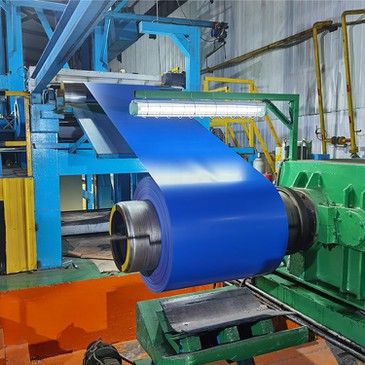
Q1: How does the substrate material affect the performance of color-coated steel coils?
A1: The substrate is the "skeleton" of the color-coated steel coil, determining the product's fundamental mechanical properties and processing capabilities, including:
Strength: Determines the load the steel sheet can withstand (such as wind pressure and snow pressure), which is crucial for building structures.
Formability: Determines whether the steel sheet will crack during bending, stamping, deep drawing, and other processing, directly affecting whether complex parts can be manufactured.
Surface Quality: The flatness and surface condition of the substrate affect the final appearance quality of the color-coated surface.
Q2: What are some common substrate material grades, and what do they mean?
A2: Substrate materials are mainly divided into two categories: general-purpose/stamping grade and structural grade. Understanding the grades is fundamental for accurate material selection.
Category | Common Grade Examples | Core Meaning Explanation
General-purpose/Stamping Grade | DX51D, TDC51D
DX52D
DX53D, DX54D | D (Cold forming) + X (Rolled state) + 51-54 (The larger the number, the stronger the stamping performance) + D (Hot-dip galvanized)
51 = General-purpose, 52 = Stamping grade, 53 = Deep drawing grade, 54 = Extra-deep drawing grade.
Structural Grade | S250GD, S350GD
S550GD | S (Structural steel) + 250 (Minimum yield strength, unit MPa) + G (Heat treatment) + D (Hot-dip galvanized) The number represents strength; common strength grades include 250, 280, 350, and 550.

Q3: How should materials be selected based on their intended use in building and industrial applications?
A3: The key to selection lies in balancing the complexity of the formwork with structural strength.
Application Scenarios | Core Requirements | Recommended Substrate Material | Reasoning
Building Roofs & Walls | Bears wind, snow, and construction loads, while maintaining a certain degree of formability | Structural Steel (S250GD - S550GD) | Prioritizes sufficient strength to bear the load. The simpler the sheet shape, the more clearly defined the strength requirements.
Appliance Housings & Furniture | Complex curved surfaces, exquisite appearance, good machinability | Stamping Steel (DX52D - DX54D) | Prioritizes excellent deep-drawing performance and surface quality to meet complex shapes and aesthetic requirements.
Ventilation Ducts & General Sheet Metal | Ordinary bending and shearing, low strength requirements | General Steel (DX51D) | Balances cost and basic formability, suitable for most non-structural components.
Q4: How do I understand the grade of the substrate for color-coated steel coils? Can you provide an example?
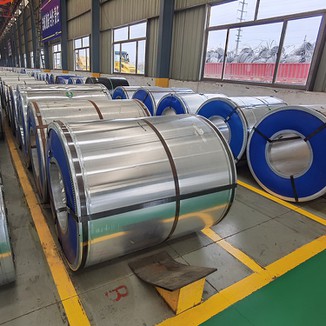
A4: The complete grade of color-coated steel coils follows the naming rule of T + substrate characteristics + + + substrate type. Wherein, "T" represents color-coated steel sheet.
Example 1: TDC51D+AZ
T: Color-coating code.
DC51D: Indicates that its substrate is a cold-forming, general-purpose hot-dip galvanized substrate with average stamping performance.
+AZ: Indicates that the substrate type is hot-dip aluminum-zinc galvanized. This grade is suitable for building components with high corrosion resistance requirements but relatively simple forming.
Q5: How to scientifically select materials and avoid risks during actual procurement?
A5: To avoid inappropriate material selection, we recommend following these three steps:
**Clarify Core Requirements:** First, determine whether your product requires load-bearing capacity (choose structural steel) or complex stamping shapes (choose stamping-grade steel). This determines whether you choose S-grade or D-grade steel.
**Pay Attention to the Zinc Ratio:** This is a crucial indicator of the corrosion resistance of the cut surface. The calculation formula is: single-sided coating weight (g/m²) / substrate thickness (mm). To ensure sufficient corrosion resistance at the cut surface, this ratio should be ≥ 100. For example, for a 0.5mm thick steel plate, the single-sided zinc coating weight should be at least 50g/m².
**Verify the Complete Grade:** Clearly specify the complete color-coated coil grade (e.g., TS280GD+Z) in the contract. Avoid using vague descriptions such as "high quality" or "first-class product" to ensure that the material and performance are verifiable.