


GNEE STEEL recently hosted a procurement and quality team from Pakistan at our stocking and processing facility. The review ran over two days. Scope: two product forms - steel plate and round bar - in three grades: AISI 1045, AISI 4140 and AISI 4130.

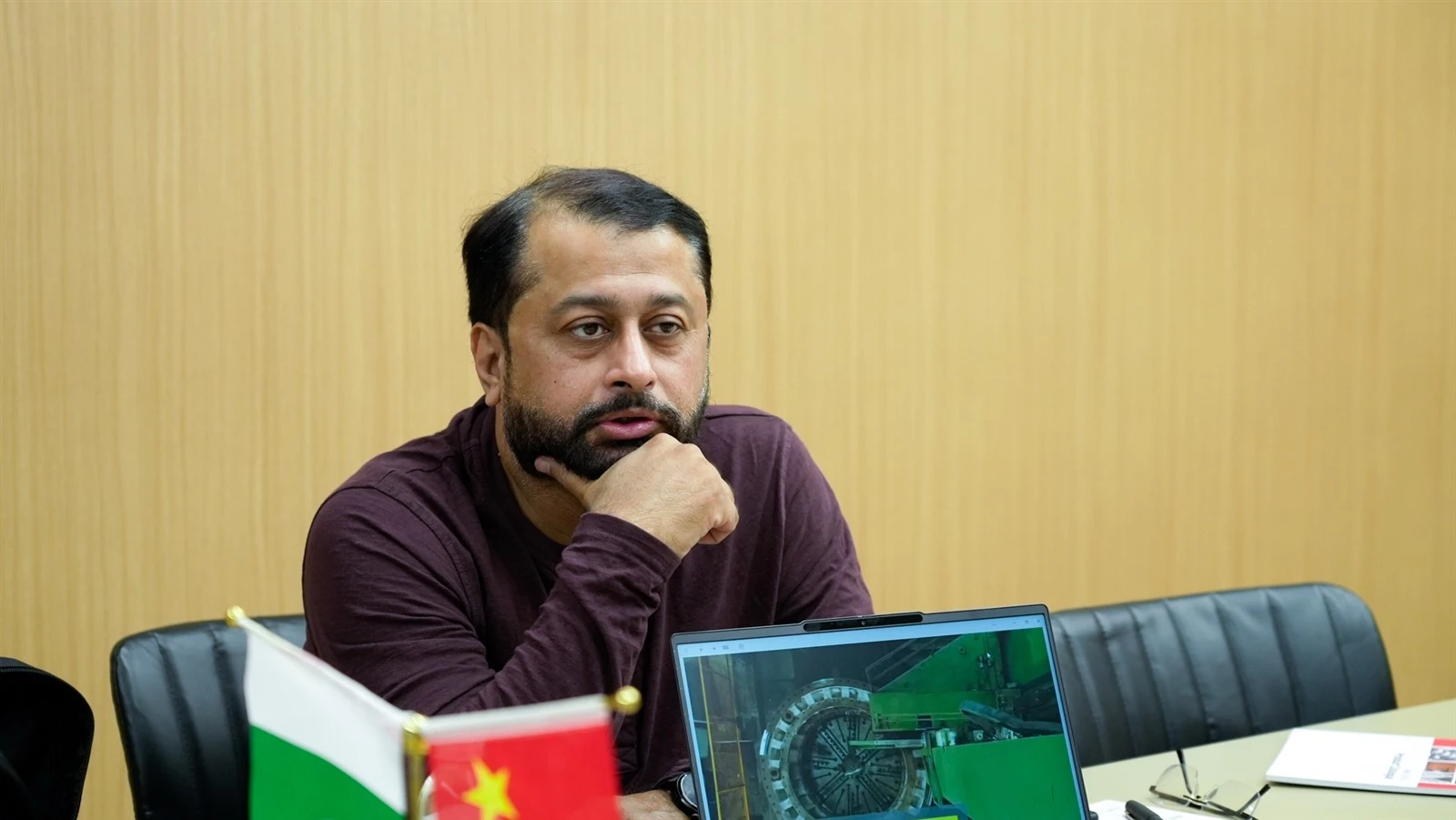

Client Visit
These grades carry much of the general engineering supply in Pakistan: textile machinery, sugar mill equipment, hydraulic shafts, gears, die holders and oilfield tooling. Buyers there specify to ASTM or AISI, and they expect the certificate to match the heat. The visit was not a tour. It was a working review of what we can hold: chemistry, hardness, tolerance, testing and packing.
1. Why These Three Grades Sit Together
1045 is a plain medium-carbon steel with no deliberate chromium, nickel or molybdenum. 4130 and 4140 are chromium-molybdenum grades separated mainly by carbon: 0.28–0.33% against 0.38–0.43%. That gap moves strength, hardenability and welding practice together, and it sets the selection order: 1045 for cost-sensitive shafts and gears you surface-harden, 4130 for welded frames, 4140 for large shafts, die holders and downhole parts.
|
Element |
1045 |
4130 |
4140 |
|
Carbon (C) |
0.43–0.50 |
0.28–0.33 |
0.38–0.43 |
|
Manganese (Mn) |
0.60–0.90 |
0.40–0.60 |
0.75–1.00 |
|
Chromium (Cr) |
- |
0.80–1.10 |
0.80–1.10 |
|
Molybdenum (Mo) |
- |
0.15–0.25 |
0.15–0.25 |
|
P max / S max |
0.040 / 0.050 |
0.035 / 0.040 |
0.035 / 0.040 |
Chemistry per SAE J403 and J404, checked against ASTM A29/A29M heat analysis.
2. Mechanical Properties
Properties depend on supply condition and ruling section. A figure printed for a 25 mm bar does not describe the same grade at 150 mm.
|
Grade and condition |
Tensile Rm (MPa) |
Yield Rp0.2 (MPa) |
Elongation |
Hardness |
|
1045, hot rolled |
570–700 |
310–450 |
16–20% |
170–210 HB |
|
1045, Q&T, tempered 540 °C, 25 mm |
~760 |
~530 |
~18% |
~220 HB |
|
4130, Q&T, moderate temper |
850–1000 |
650–750 |
15–20% |
22–28 HRC |
|
4140, Q&T, moderate temper |
1000–1200 |
850–1000 |
12–15% |
28–32 HRC |
Typical figures from published data, not guaranteed values. The mill test certificate governs what you receive.
Two rules of thumb came up at the table. 1045 through-hardens reliably to roughly 20–25 mm in water; past that the core stays soft, and induction hardening is the better route, giving 54–60 HRC at the surface with a core near 180 HB. 4140 through-hardens to about 100 mm in oil, while 4130 reaches about 50 mm. So the drawing must state the ruling section, not just the grade. Welding follows the same logic: 4140 carries a carbon equivalent around 0.75–0.85 and needs preheat near 300–400 °C; 4130 sits near 0.55–0.65 and welds more easily; 1045 needs preheat around 200–300 °C and post-weld tempering.
3. Cross-Standard Equivalents
|
AISI / SAE |
EN / DIN |
Werkstoff |
JIS |
GB/T |
|
1045 |
C45 (EN 10083-2) |
1.0503 |
S45C (JIS G4051) |
45 (GB/T 699) |
|
4130 |
25CrMo4 (EN 10083-3) |
1.7218 |
SCM430 (JIS G4105) |
30CrMo (GB/T 3077) |
|
4140 |
42CrMo4 (EN 10083-3) |
1.7225 |
SCM440 (JIS G4053) |
42CrMo (GB/T 3077) |
Equivalents are close, not identical. They differ in hardenability bands and impurity limits. Name the governing standard on the purchase order.
4. Where Shipments of These Grades Usually Go Wrong
Large orders rarely fail on chemistry. They fail on the details around it.
Hardness spread across a batch that nobody checked
Q&T values quoted without a ruling section
Decarburization left on hot-rolled surfaces, found after hardening
Mixed heats in one container, which breaks traceability
5. How We Ship Plate and Round Bar
We choose container or break bulk on three things: piece length, piece weight and total tonnage. Bar and cut plate that fit the payload and internal length move by container - 20GP, 40GP or 40HQ. Over-length or over-width plate moves on flat rack, open top or break bulk. At stuffing, the points are fixed: dunnage between layers, strapped bundles, protected ends, moisture barrier, even weight spread, full lashing. Documents travel with the goods: EN 10204 3.1 mill certificate, packing list, commercial invoice, certificate of origin and bill of lading.
6. FAQ
1.What is the difference between 1045, 4130 and 4140?
1045 is a plain medium-carbon steel. 4130 and 4140 are chromium-molybdenum alloy grades. 4140 carries more carbon, so it is stronger and harder, and it needs more care in welding.
2.Can 4140 be welded?
Yes, with control: preheat near 300–400 °C, low-hydrogen consumables, controlled interpass temperature, then stress relief. For heavily welded designs, 4130 is the safer choice.
3.What certificate comes with the material?
EN 10204 3.1 as standard, issued against the actual heat. EN 10204 3.2 and third-party inspection by SGS, BV or TÜV can be arranged.
4.What is your minimum quantity and lead time?
Standard minimum is 200 kg. Stock sizes ship in 5–10 days. Non-stock sizes and heat-treated bars take 15–30 days.