


Corrugated galvanized sheet metal is a low-carbon steel sheet coated with zinc through the hot-dip galvanizing process, then roll-formed into a repeating wave profile. The wave shape adds bending stiffness without adding weight, and the zinc layer protects the steel against atmospheric corrosion. This combination of low cost, light weight, and long service life has made corrugated galvanized sheet one of the most widely used roofing and cladding materials in the world.
1. How It Is Made: Coil First, Profile Second
Production starts from a galvanized steel coil, not from a flat sheet. The mill coats the wide coil on a continuous hot-dip galvanizing line, and a roll former presses the wave profile into the coated strip. Two decisions come before forming:
- Coating class. Roofing grades commonly run Z100–Z275 (grams of zinc per square metre, total both sides) under EN 10346. Coastal sites should start at Z275.
- Base thickness. Roofing commonly uses 0.30–0.50 mm. Wall cladding uses 0.40–0.60 mm. Industrial roofs and wide purlin spacing call for 0.55–0.80 mm.
Because the zinc is applied before forming, cut edges and punched holes still carry sacrificial protection. The zinc beside the bare steel corrodes first, so small cuts do not turn into spreading rust. That single property separates galvanized sheet from painted bare steel, where every scratch is a starting point for corrosion.
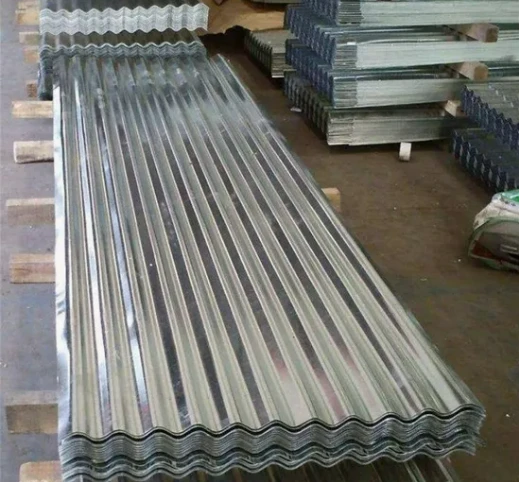
Galvanized corrugated metal sheet
2. The Number Most Buyers Get Wrong: Effective Coverage
A corrugated sheet does not cover its own full width. The waves overlap the neighbouring sheet, and that side lap is lost area. This is the most common cause of a short delivery.
|
Profile |
Sheet width |
Effective coverage |
Side lap loss |
|
Sinusoidal 8.5 |
700 mm |
610 mm |
about 13% |
|
Sinusoidal 10.5 |
840 mm |
762 mm |
about 9% |
|
IBR |
740 mm |
686 mm |
about 7% |
The side lap rule is simple: sinusoidal sheets overlap one and a half waves, IBR sheets overlap one wave. The consequence is arithmetic. A 10 metre wide roof covered with the 700 mm profile needs about 17 sheets across, not 15. Always calculate quantities from effective coverage, never from sheet width. If your supplier quotes coverage without stating the profile, ask for the profile drawing before you confirm the order.
3. Standards and What the Certificate Must Show
The same product is sold under three major standards, and the coating grades do not use the same names.
|
Standard |
Coating grades |
Common market |
|
EN 10346 |
Z100 to Z600 |
Europe, Africa, Middle East |
|
ASTM A653 |
G40 to G90 |
Americas |
|
JIS G3302 |
Z12 to Z60 |
Japan, Southeast Asia |
One certificate rule matters more than the rest: the mill certificate must report both the three-point average and the single-point minimum coating weight. For Z275, the single-point minimum is 235 g/m². A coil that only shows an average value can still fail a single-point inspection, and by then it is already packed. State the acceptance basis in the order, not after arrival.
4. Roofing Geometry: Slope, End Lap, and Purlins
Minimum slope: sinusoidal profiles work from roughly 7.5° to 10°. Below that, water can back up the side lap.
End lap: above a 15° slope, an end lap of about 150 mm is normal. Lower slopes need about 250 mm, sealed.
Purlin spacing depends on thickness and on profile depth. The wave itself carries stiffness, so thickness alone is not the only lever. Treat published spacing values as indicative and have an engineer confirm them for your wind and snow loads.
Client Case Studies
We were delighted to host our valued Pakistani client at GNEE STEEL. During the factory visit, our team showed the full production process and conducted on-site quality checks for galvanized corrugated sheets. Witnessing our rigorous quality control and production capacity, the customer placed the order directly on site. We promise consistent product quality, on-time shipment and professional after-sales support. We sincerely hope to establish stable, long-term cooperation and supply reliable roofing materials for local construction projects.



FAQ
1.Is corrugated galvanized sheet the same as galvalume?
No. Galvanized carries a zinc coating; galvalume carries a zinc-aluminium coating. Galvalume lasts longer on flat surfaces, while zinc gives stronger sacrificial protection at cut edges. The right choice depends on your environment and on how many cut edges the design produces.
2.How long does corrugated galvanized sheet last?
Indicatively 10 to 30 years outdoors, depending on coating class and environment. Z275 in a rural atmosphere lasts far longer than Z100 near the coast or in industrial air. Treat these as planning figures, not a design life.
3.What thickness should I choose?
0.30–0.50 mm covers most roofs. Use 0.55–0.80 mm for wide purlin spacing or industrial buildings. Order in millimetres, because gauge numbers differ between markets.
4.How many sheets do I need per square metre?
Divide the roof area by the effective coverage, not by the sheet width. For a 700/610 mm profile, add roughly 15% more sheets than the width-based number.